Monday, 6 August 2012

Friday, 3 August 2012
Syria resolution goes to UN assembly vote
| AL Jazeera English Middle East |
|
UN prepares to denounce Syria for unleashing tanks and air power, and demand regime refrain from chemical weapons use.
Last Modified: 03 Aug 2012 08:03
|
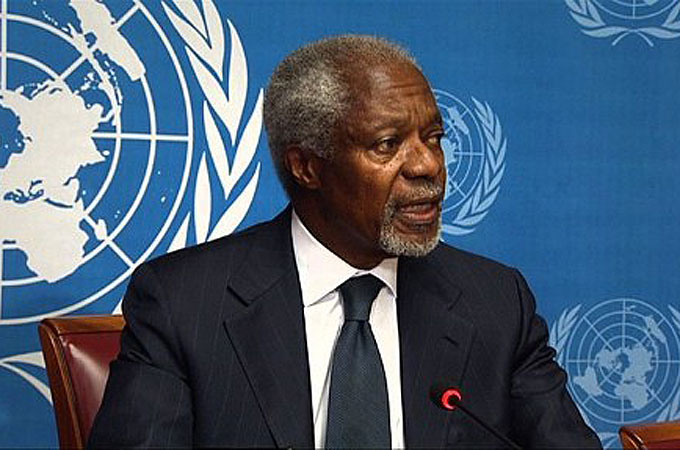
Kofi Annan, the joint UN-Arab League envoy to Syria, has resigned after his peace proposals failed [AFP]
|
|
The UN General Assembly is expected to vote on a
resolution that criticises the Security Council for failing to take
action on Syria. The UN prepared on Friday to denounce Syria for unleashing tanks, artillery, helicopters and warplanes on the people of Aleppo and Damascus. The resolution will reportedly demand that the Assad regime keep its chemical and biological weapons warehoused and under strict control. The anti-Syria resolution was expected to easily pass in the 193-member General Assembly after its Arab sponsors were forced to drop two key provisions in the original draft: a demand that President Bashar al-Assad resign, and a call for other nations to place sanctions on Syria over its civil war. The resolution also calls on authorities in Damascus to cease human rights violations and withdraw troops from population centres. As with all General Assembly resolutions, this one is non-binding and carries only symbolic power. But UN peacekeeping chief Herve Ladsous told the Security Council on Thursday that UN military observers in Aleppo are seeing “a considerable buildup of military means, where we have reason to believe that the main battle is about to start”. The rebels have commandeered tanks, and are bringing them into combat as Syrian warplanes strike back. "Even in Damascus, I was there a few days ago, one could hear explosions regularly, interminably,'' Ladsous told reporters after briefing the council. UN Secretary-General Ban Ki-moon urged restraint on all sides, saying, “Both the government and the opposition forces continue to demonstrate their determination to rely on ever-increasing violence.” The resolution that began to circulate on Monday reaffirmed its support for Kofi Annan, but he resigned on Thursday as the joint UN-Arab League envoy to Syria after his peace proposals failed. The original draft had called for Assad to resign, highlighting an Arab League call on July 22 for “the Syrian president to step down from power, in order to facilitate a peaceful political transition”. Russia, which has consistently supported Syria at the United Nations, said it would not back the resolution because it was unbalanced and would encourage rebels to keep fighting. Vitaly Churkin, the Russian Ambassador, said on Thursday he could not support the General Assembly's “extremely unbalanced and one-sided resolution". Russia and China opposed the draft, as expected. Both countries have cast a double-veto in the Security Council three times to kill resolutions that could have opened the door to sanctions on Syria, or even military intervention. |


Is Somalia ready for real democracy?
| AL Jazeera English Inside Story | |||
|
As the country gears up for a new government we ask if it will be able to overcome corruption and internal conflicts.
Inside Story
Last Modified: 03 Aug 2012 06:52
|
|||
|
|
|||
|
After a week-long debate Somalia's National
Constituent Assembly has endorsed a new constitution, marking an end to a
series of transitional administrations over the past 20 years. A new parliament is to be elected by the country's traditional elders, and that body will then choose a president and elect a government.
But many are doubtful that these aims can be achieved in a divided state marked by violence and instability. Despite the approval of the provisional constitution, the country still faces many challenges. Last month a leaked UN report said key leaders at the very top of the transitional government were in corruption. This has boosted the cause of al-Qaeda and al-Shabab in Somalia, seen as a serious threat to peace not only in the country but the region as a whole. All this while Somalia has relied heavily on foreign aid and has been battling poverty.
"The next step is to form a new parliament. Today’s step [the provisional constitution] was a major step in the Somali peace process because it completed one of the major steps in the ending of the transition, that is the adoption of a provisional constitution. "The same elders who selected the delegates today [for the] National Constituent Assembly, will proceed to select the members for a new parliament. This should happen early next week and that parliament will elect the president, the speaker and the deputy speaker on August 20." In this episode Inside Story asks: Will the provisional constitution help deliver peace to a country ravaged by more than two decades of civil war? Is Somalia ready for real democracy? Joining the discussion with presenter Mike Hanna are guests: Muhdin Mohammed Ali, the founder and director of Somali Policy, a political think tank; Abdulkareem Jama, a former information minister and also the secretary-general of Daljir Forum, a group that aims to foster rigorous debate on Somalia's future; and Abdurahman Hosh Jibril, the minister of constitution affairs and reconciliation of Somalia's transitional government.
SOMALIA IN TRANSITION:
|
Subscribe to:
Posts (Atom)